

Most dentists buy a cone beam on price rather than need. I understand why. The quotes are large, the spec sheets look alike, and a lower number feels like the safe choice. Some practices go further and buy a used unit to keep the first check small.
However, the way practices use CBCT has changed. Implants, endodontics, airway and orthodontics now lean on 3D every week, and in many offices the panoramic exam runs through the same machine. Consequently, the cone beam is no longer an occasional tool. When it stops, a large part of the diagnostic day stops with it.
It is also an ongoing expense, not a one-time purchase. Here is the pattern I see most often. A practice buys a unit priced around $35,000 with a three-year warranty. The unit was often designed years earlier, so the practice is buying at the end of the obsolescence cycle, not the beginning. They finance it over five or more years, which means they are still making payments after the warranty has expired. From that point every repair, every technician visit and every computer problem is theirs to pay for, on a machine they still owe money on. Cheaper units also tend to come with capability restrictions: smaller fields of view, single-purpose imaging, or features sold as add-ons. Then the practice finds it needs a bigger field or a better pan, and it starts shopping again.
That is the trap. The low price is real; the low cost is not.
The fear underneath all of this is simple: being stranded with an expensive machine and nobody who owns the problem. That fear deserves a straight answer, and that is why we built No Worries, No Hassles. First, though, the technology.
What a cone beam actually does
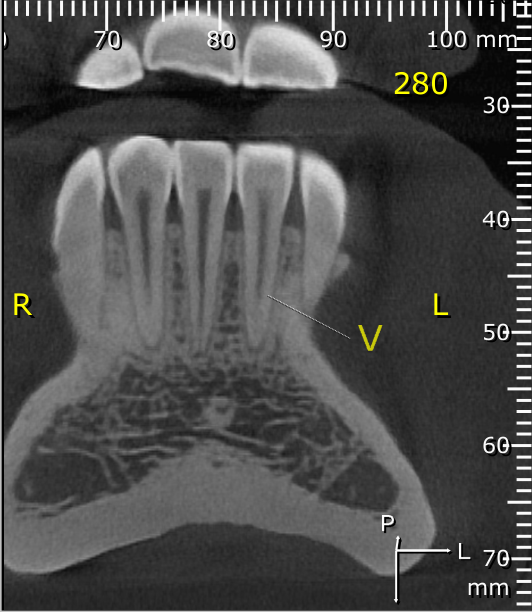
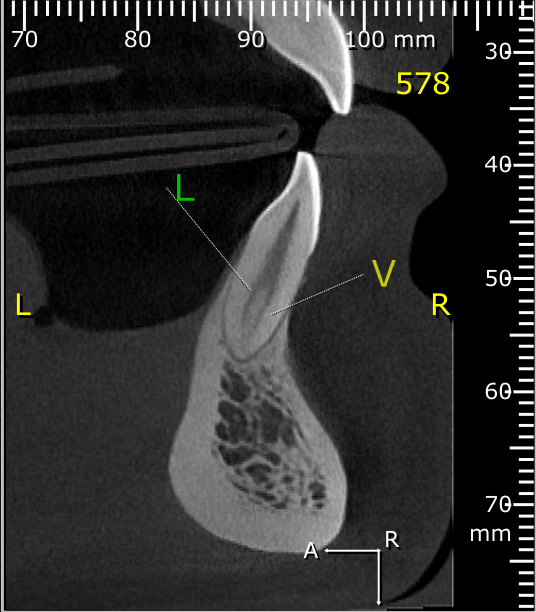
A CBCT unit rotates an X-ray source and detector around the patient's head and reconstructs the data into a three-dimensional volume. Instead of reading overlapping structures on a flat image, you scroll through the anatomy in any plane. The American Association of Endodontists and the American Academy of Oral and Maxillofacial Radiology put it plainly: CBCT made it possible to see the dentition, the maxillofacial skeleton and the relationship of anatomic structures in three dimensions (AAE and AAOMR joint position statement).
That relationship is the point. When the position of a root, a canal, a nerve or a sinus changes the treatment plan, a 2D image leaves you to watch and wait. For endodontics, the same statement names limited field-of-view CBCT as the imaging modality of choice in specific situations, such as contradictory or nonspecific signs and symptoms and the evaluation of nonhealing previous treatment.
One unit, three exams: 3D cone beam, 2D panoramic and ceph. Dual focal spot, one for CBCT and one for panoramic.
One volume, four perspectives.
Follow the anatomy across each plane.
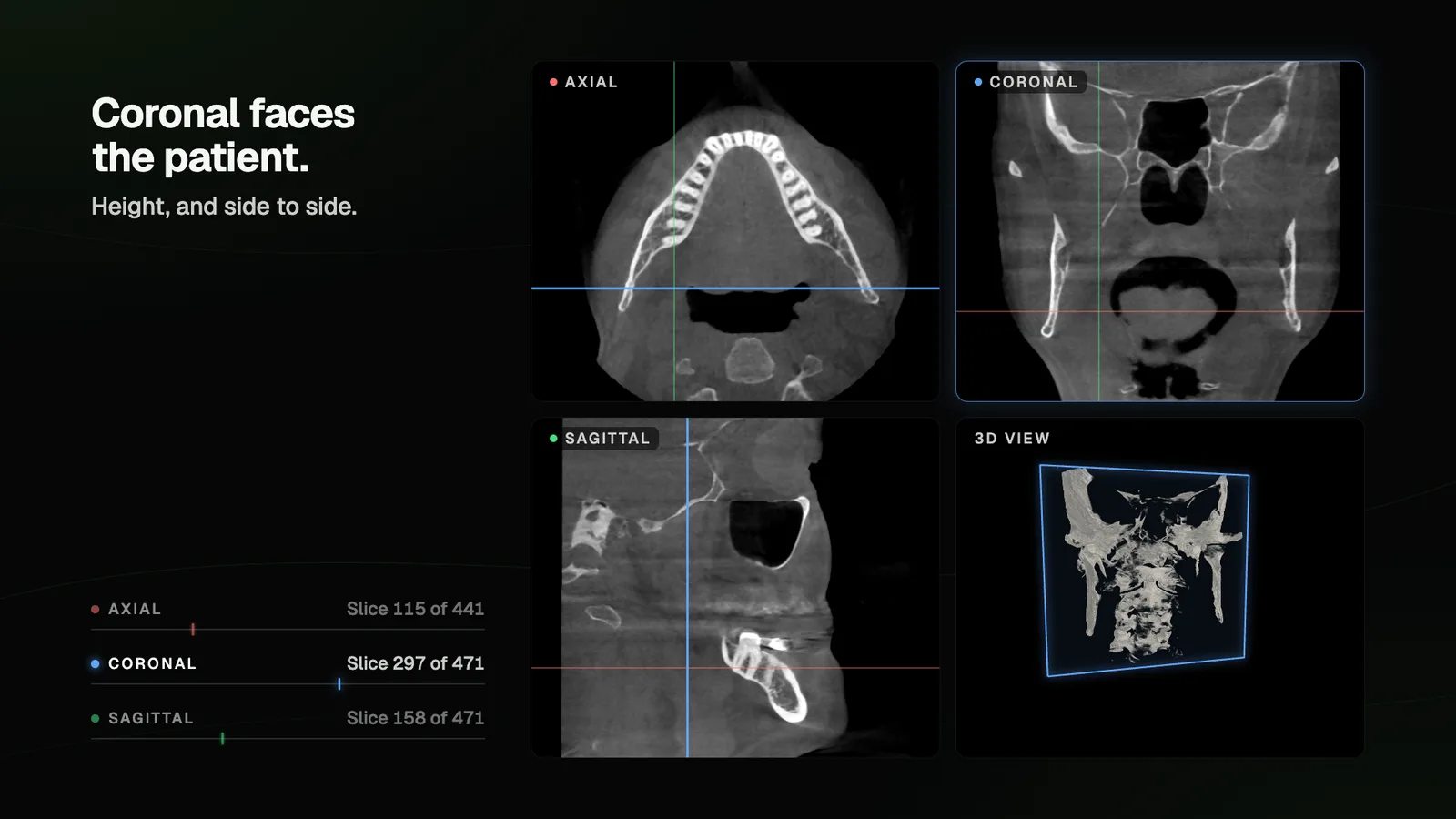
Connect the slices to the 3D view.
Watch the five-minute lessonYou use it on purpose
CBCT is ionizing radiation, and the dose depends heavily on the field of view and exposure settings. It can be higher than the intraoral and panoramic images you take every day. The ADA Council on Scientific Affairs says CBCT should follow a history and clinical exam, be justified by expected benefit, not be used for screening, and keep dose as low as reasonably achievable (ADA advisory statement). The FDA points the same way (FDA on dental CBCT).
Dental imaging has since sharpened that idea. ALADA, "as low as diagnostically acceptable," was proposed at the 2014 NCRP annual meeting as a variation of ALARA focused on getting a diagnostic image rather than the prettiest one (FDI policy statement on radiation safety). Researchers then extended it to ALADAIP, which adds "indication-oriented and patient-specific" (critical review of ALARA, ALADA and ALADAIP). These are refinements, not official replacements, and they all say the same thing: the right scan, at the right size, for the right reason.
That has a buying consequence. You want a machine that lets you match the scan to the question, and the AAE and AAOMR note that smaller volumes generally produce higher-resolution images with less dose. The PreXion Elite's acquisition area runs from Ø5x5 up to Ø16x21, selected by clinical indication, so a single-tooth question doesn't need a full-head scan. To be clear about the trade-off: the largest field, 16x21, is captured in two scans. The 16x15 field is a single scan.
Cone beams age, and the computer ages faster
A cone beam is built to last. In our experience most units run on roughly a ten-year life cycle, and a next generation typically arrives somewhere between year seven and year ten. That matches the broader imaging industry: COCIR, the European medical imaging trade association, says equipment six to ten years old generally remains fit for purpose but should have a replacement plan, and equipment over ten years old becomes increasingly hard to maintain and repair (COCIR age profile).
The workstation runs on a different clock. It is a PC with an operating system that has its own support calendar. Microsoft ended Windows 10 support on October 14, 2025; those computers still run, but they no longer get security updates (Microsoft). In practice the server or PC needs replacing somewhere around the five-year mark, while the X-ray unit itself is still perfectly good. Someone has to plan, buy, install and set up that replacement with the imaging software. In most purchases, that someone is you.
One system. Two replacement clocks.
Plan the workstation refresh while the scanner is still doing its job.
Imaging equipment
Capability for the years ahead
Workstation
Hardware, software and setup
and reconfigure
What really goes wrong
In the field, the problems that hurt practices come down to two things: time and ownership.
1. Downtime. When the unit is down, scans get rescheduled or referred out, and the case you bought the machine for walks out the door.
2. Service gaps. A dealer changes lines or closes, the manufacturer and the dealer each point at the other, or the warranty covers the part and leaves you paying for the technician.
3. The aging PC nobody budgeted for. It fails at the worst moment, and the replacement is a project, not a purchase.
Put those together and you get the stranded feeling dentists describe to me. None of it is about image quality.
A steady head means fewer retakes. The Elite pairs a fully adjustable carbon-fiber headrest with patient motion correction built in.
What matters when you buy: specs, then service
Specs matter, so let's be specific. The PreXion Elite, per PreXion's own literature, offers:
A 48 micron voxel at its smallest setting.
A 0.17 millimeter focal spot for CBCT.
A dual focal spot for CBCT and panoramic, so the pan is not a compromise bolted onto a 3D tube.
Patient motion correction built in and metal artifact removal built in, not sold as add-ons.
A 120 kilovolt tube with cooling built in for continuous use. PreXion's brochure doesn't list tube voltage; the 60 to 120 kV range comes from PreXion's internal 2026 sales deck. PreXion rates the Elite for up to 300 scans a day.
No compromises is an easy phrase to print. Here it means the features above come standard, so you are not discovering a capability restriction two years after you sign.
However, the spec sheet only answers half the question. Before you buy any cone beam, ask three more:
1. Who answers the phone when something breaks, and how fast does the fix start?
2. Who replaces the computer, and when?
3. What happens at year ten, when the unit is paid for and a better one is on the market?
Most purchases leave those answers to the practice. We built a program that answers all three before you sign.
Cooling is built in for continuous usage, so a busy day doesn't mean waiting on the machine. PreXion rates the Elite for up to 300 scans a day.
A 0.17 mm focal spot and a 48 micron voxel. Patient motion correction and metal artifact reduction are built in, with no compromises and no add-ons to buy.
No Worries, No Hassles: DentalTI no hassles no worries, backed by PreXion
Here is how I describe it: a ten-year comprehensive concierge service warranty where parts and labor are covered, service is included when something goes wrong, your PC is replaced on schedule at the end of its five-year Dell warranty, and you do not have to think about any of it.
Dental TI developed No Worries, No Hassles, and PreXion, the manufacturer, sponsors it. PreXion runs it from start to finish, so the company that builds the machine owns the service, the parts and the computer. If PreXion needs us to arrange something locally, they call us. You don't coordinate any of it.
What's covered
The cone beam and its computer are covered for ten years. The PC comes with a five-year, next-day, in-office Dell Gold/Precision warranty that covers the first five years. We schedule the replacement as close to the end of that five-year cycle as possible, so your imaging software stays on current hardware. The replacement PC carries its own five-year Dell warranty, which takes the coverage out to the ten-year mark. At that point, one of two things happens: either the machine is out of warranty and a new PC is installed, or you turn the unit in and restart the ten-year program, with the same consistent, covered expense. The full terms are in the written program agreement, and we will walk through it with you before you sign. Read it. If it does not fit your practice, I would rather you know that now.
When something goes wrong
You call PreXion, and the call is answered within two rings. The problem is diagnosed remotely the same day, and the fix starts immediately, with expedited same-day professional service, remote or on-site as the problem requires. Many issues are resolved remotely; a technician comes out when the problem calls for it.
Year ten is already planned
At the ten-year mark, PreXion replaces the unit and the computer with the current generation, at roughly the same payment for the next ten years. Replacement and financing are arranged only if you choose that option.
Before that date, PreXion sends you a letter with three choices:
1. Re-up with the new unit.
2. Keep your current unit, with the option of a monthly service contract.
3. Keep your current unit with no service contract.
All options are available to you.
Year ten: two ways to get there
Picture the opposite of the Elite. A practice buys a $30,000 to $40,000 cone beam with a three-year warranty. Sometime after year three it fails early, and the repair costs several thousand dollars. So they trade it in and buy a second unit, a cheap-to-mid machine around $50,000. That one doesn't fail. But look at what it cost: more money than the premium unit would have, a stretch with the wrong capability when they needed it, and no support when they needed that too. The juice wasn't worth the squeeze.
Now the Elite, which is the No Worries, No Hassles way. It has the broadest capability I know of in cone beam in its price range, and I don't know of anyone who has better:
Fields of view for every indication. From Ø5x5 to Ø16x21, chosen by what you are treating (the 16x21 takes two scans; the 16x15 takes one).
A real panoramic. A focal spot ideal for pano, and a separate focal spot optimized for CBCT.
The latest cone beam technology. Patient motion correction and metal artifact reduction are built in.
Resolution at the top of the field. A 48 micron voxel and a 0.17 mm focal spot.
A unit like this has many years before it is obsolete. That is why ten years is a fair stretch to keep it, and why you still feel current at the end of it. Parts and labor are covered the whole way, with service included when something goes wrong. Then you start over with the newest, latest and greatest, and the next ten years begin the way the first ten did.
Here is what that looks like in dollars. The Elite plan comes to about $1,400 a month. Over a month of 20 working days, that is $70 a day. At 15 patients a day, it is about $4.67 a patient. That is one number, set once, for the unit, the coverage and the computer. The cheaper path never gives you a number like that, because you don't know when the repair bill or the second purchase will arrive. (If you want the actual Elite payment for your practice, we'll run it with you; it depends on the configuration and the financing.)
The numbers, side by side
Here is the arithmetic, so you can check it yourself. The Elite at its normal price (not the introductory price) is $90,000. Add the $15,000 concierge program and the $6,000 PC, and you have $111,000. With 7% tax, that is $118,770. Financed over the full ten years at 8.1%, the payment is about $1,448 a month. If you take the manufacturer's $3,000 rebate as a reduction in the amount financed, it is about $1,411, which is the roughly $1,400 a month, $70 a working day, and $4.70 a patient at 15 patients a day. The ten-year program covers parts and labor for that whole period, with service included when something goes wrong.
Now the cheaper path, using the same rate for a fair comparison (your own lender's rate will differ):
| Cheap unit, then a second one | PreXion Elite, No Worries, No Hassles | |
|---|---|---|
| Purchase, with tax | About $40,000, then about $50,000 | $118,770 |
| Financed over | 3 years, then 5 years | 10 years |
| Monthly payment | About $1,255, then about $1,016 | About $1,448 |
| Paid in the first 8 years | About $106,000, plus any repair outside warranty | About $139,000 |
| Coverage | Three-year warranty, then you pay | Parts and labor, ten years; service included |
| Downtime | A failure outside warranty means the unit is down while it is repaired or replaced | Same-day remote diagnosis, expedited service, covered |
| What you can image | What that unit does, which often falls short of what you want | Every field of view, a real pan, the latest technology |
| Performance | A budget machine, not elite performance | The resolution and capability at the top of the field |
I'm not going to tell you the cheap path has the higher payment, because on these numbers it doesn't. The cheap payment is lower while it lasts. What the cheap path doesn't tell you up front is what it leaves out: the repair bill after the three years are up, a second purchase on top of the first, a machine that lacks what you need on the day you need it, and nobody who owns the problem. At the end of that road you have no program, no replacement plan, and a decade-old machine's worth of questions. With the Elite you have a number you can plan around, and at year ten you start over on the newest unit.
What it comes to per patient
Spread the payments over your patients and the gap gets small. At 20 working days a month and 15 patients a day, that is 300 patients a month:
Elite: about $1,448 a month is $4.83 a patient, or $4.70 with the $3,000 rebate taken off the financing.
Cheap unit, first three years: about $1,255 a month is $4.18 a patient. The Elite costs about 65 cents more per patient, or about 52 cents with the rebate.
Second unit, years four to eight: about $1,016 a month is $3.39 a patient. The Elite costs about $1.30 to $1.45 more per patient in those years.
Averaged over the first eight years: the Elite costs about a dollar more per patient (roughly $1.14, or $1.02 with the rebate).
So the difference is under a dollar a patient in the first three years and about a dollar a patient across the eight. For that, you get ten years of covered parts and labor, service included when something goes wrong, and the capability you wanted when you bought it. These figures assume 15 patients a day, and every patient does not need a scan, so your own per-scan numbers will differ.
For the savvy dentist
The price is what you pay once. The cost is what you carry for years. A careful buying decision accounts for both.
Start with the capability your practice needs. Then work through the service, the computer and the years you expect to use the system. A lower purchase price is useful only if the machine still does the work you bought it for.
That is the idea behind No Worries, No Hassles: plan the next ten years before the first scan. Put the equipment, covered service and workstation replacement on the same planning horizon, with clear responsibilities and written terms. You should know who owns the problem when something goes wrong.
Keep your cash working in the practice
Writing a check is one way to buy a cone beam. Financing can let you keep cash in the practice while spreading the equipment and eligible support costs over time.
But a payment is only useful if you know what it buys. Look at the full proposal: the system, the coverage, the computer plan, the financing cost and anything that remains your responsibility. Ask for the total over the term, not just the monthly number.
Match the financing to the years you expect to rely on the unit. Plan for the workstation to age sooner. Have the conversation about service before you need it. That is how the ownership picture becomes something you can budget for.
We’re looking for 20 PreXion Elite KOL practices
We are looking for 20 practices to help introduce the new PreXion Elite as key opinion leaders, or KOLs. We want to hear what happens when the system becomes part of your working day: the cases you use it for, how your team works with it and what you learn along the way.
In return for KOL participation, we will put a configuration-specific offer in writing. We will walk through the equipment, participation requirements, program pricing and proposed ownership plan before you decide.
We ask participating practices to do three things:
1. Share anonymized patient scans following Dental TI’s submission instructions.
2. Contribute to a blog article about your and your team’s experience with the Elite.
3. Occasionally take a call from a colleague who is considering the system.
The point is practical experience that another dentist can use. If you are considering Elite and are willing to share that experience, talk to us about the KOL opportunity. You can explore the system with us whether or not participation is a fit.
Talk to us before you buy
Bring your case mix, the scans you refer out today and the questions you want answered, including the hard ones. We will show you the Elite’s imaging range and work through the ownership proposal with you.
Ask about the parts and labor. Ask about the computer. Ask what happens when it is time to move to the next generation. I would rather answer those questions before you buy than have you discover a gap afterward.
If the system or the plan does not fit your practice, we will tell you. If it does, you will know what you are buying and how you intend to own it.
Buy the capability your practice needs, with a clear plan for the years you will rely on it.